LTE / NB-IoT Networks
Some Lobaro devices support mobile connections such as NB-IoT or LTE-Cat-M1. This page provides background information and technical details related to mobile connectivity.
For configuration parameters related to LTE connectivity, see: LTE Network Configuration
Signal Strength
The signal strength of an LTE-M or NB-IoT connection is described by the RSRP and RSRQ values:
RSRP − 140 = dBmRSRQ / 2 − 19.5 = dB
| Coverage | RSRP (raw) | RSRP (dBm) | RSRQ (raw) | RSRQ (dB) |
|---|---|---|---|---|
| Average power received | Average power received (dBm) | Average receive quality | Average receive quality (dB) | |
| Excellent | 80 – 97 | −60 to −44 | 28 – 34 | −5.5 to −3 |
| Good | 60 – 79 | −80 to −61 | 21 – 27 | −9 to −6 |
| Mid Cell | 40 – 59 | −100 to −81 | 14 – 20 | −12.5 to −9.5 |
| Cell Edge | 20 – 39 | −120 to −101 | 7 – 13 | −16 to −13 |
| Unstable | 0 – 20 | −140 to −121 | 0 – 7 | −19.5 to −16.5 |
The actual connection statistics of your device are shown in the Lobaro Platform under Device Properties.
For unstable network coverage, Lobaro cannot guarantee correct function of cellular uplinks and battery runtimes under all conditions. Consider relocating the device.
Source: Nordic Semiconductor – AT Command Reference
Network Coverage
NB-IoT coverage maps for Europe: iotcreators.com/network
To test coverage in the field, connect your device via the USB Config Adapter and observe the log using the Lobaro Config Tool. Alternatively, use a professional 3rd-party network tester, e.g. from ENQT.
NB-IoT / LTE-M Frequency Bands
| Band | Uplink (TX) | Downlink (RX) | Bandwidth | Used by |
|---|---|---|---|---|
| B3 | 1710 – 1785 MHz | 1805 – 1880 MHz | 75 MHz | – |
| B8 | 880 – 915 MHz | 925 – 960 MHz | 25 MHz | Telekom |
| B20 | 832 – 862 MHz | 791 – 821 MHz | 30 MHz | Vodafone |
The NB-IoT bands selected for Europe are B3 (1800 MHz), B8 (900 MHz) and B20 (800 MHz). B8 and B20 are supported by all Lobaro devices; B3 may be available on more recent variants.
Operators may change bands without prior notice.
Geo Location Lookup
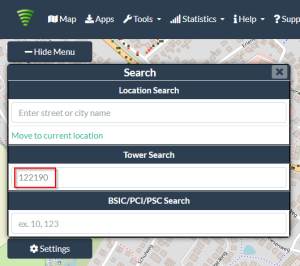
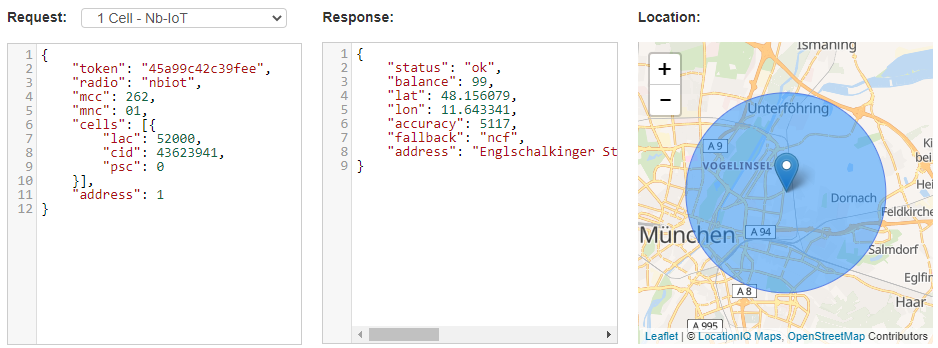
To look up the physical location of a mobile device, the following values from the device status packet are required:
- TAC (Tracking Area Code / Location Area Code) – e.g.
0xcb20= 52000 - CI (Cell ID) – e.g.
0x299A605= 43623941
| Resource | Description |
|---|---|
| cellmapper.net | Cell lookup. ⚠️ Account required, not for commercial use. Platform eNodeB towerID is derived from CI: towerID = parseInt(ci / 256, 10) |
| my.unwiredlabs.com | LTE Location API – account required |
LTE Error Codes
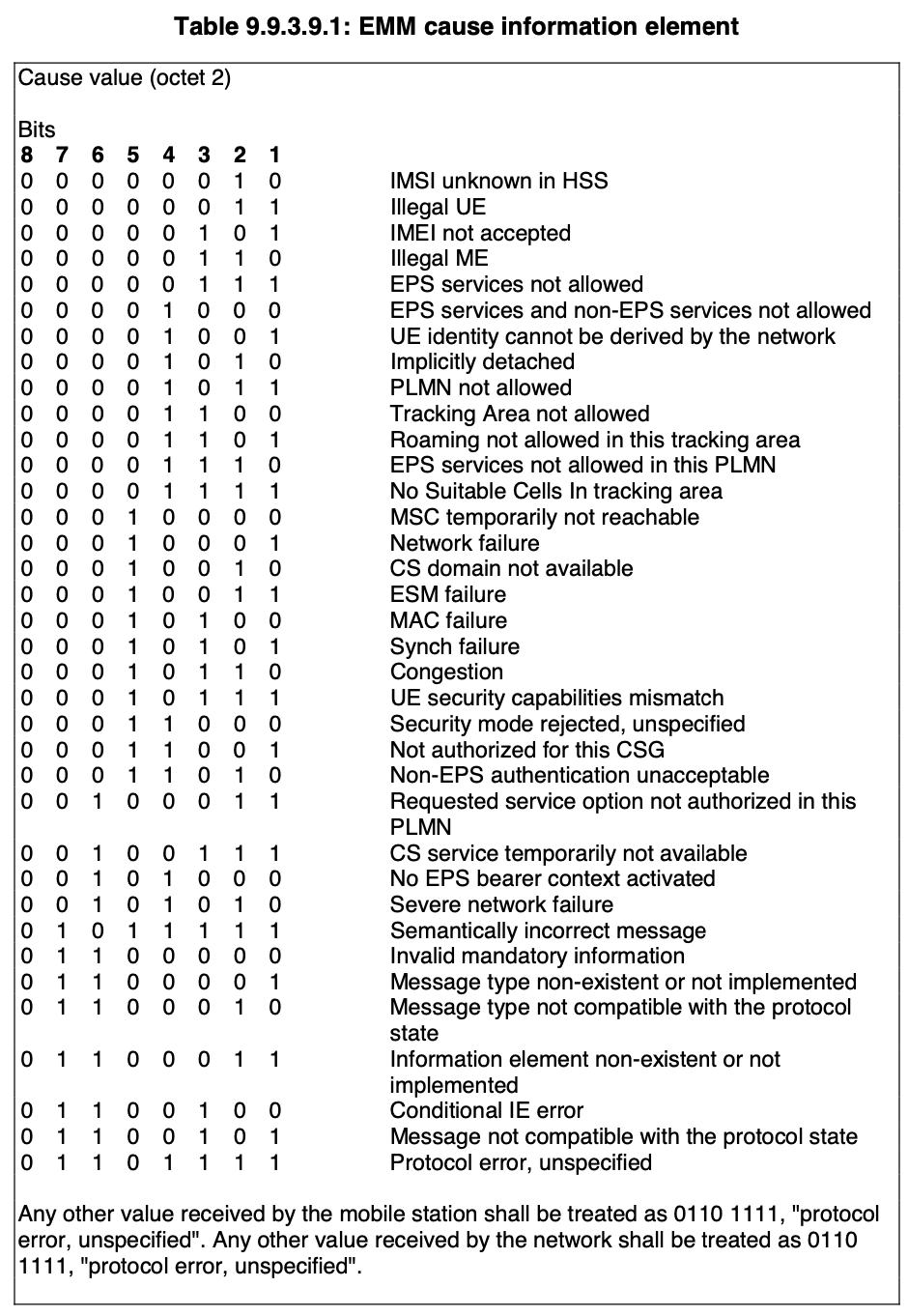
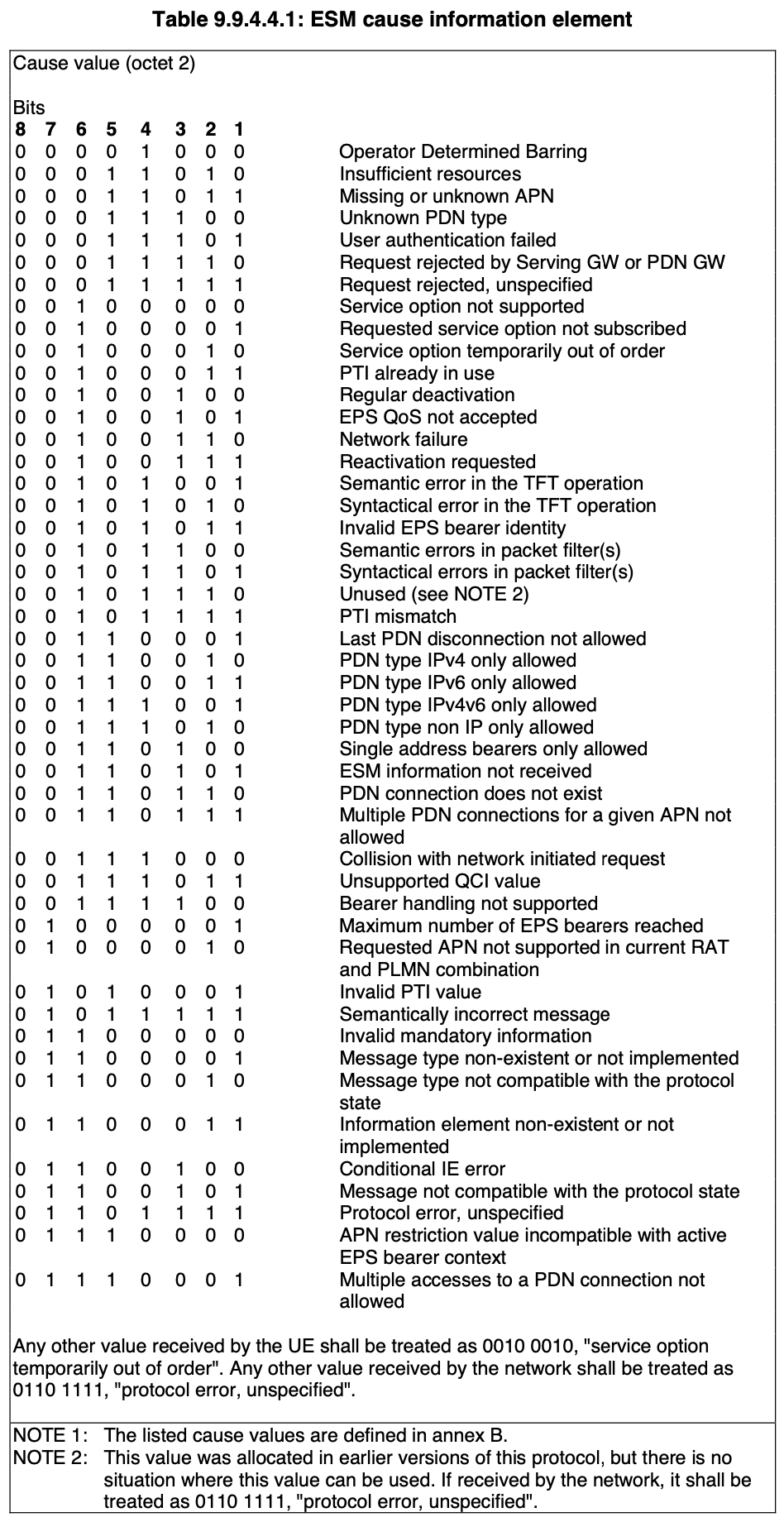
Newer Lobaro firmware versions report ESM (EPS Session Management) and EMM (EPS Mobility Management) error codes in status uploads.
Source: ETSI TS 124 301 V14.5.0
EMM Cause Codes
Source: ETSI TS 124 301 V14.5.0 – Table 9.9.3.9.1
| Code | Description |
|---|---|
| 2 | IMSI unknown in HSS |
| 3 | Illegal UE |
| 5 | IMEI not accepted |
| 6 | Illegal ME |
| 7 | EPS services not allowed |
| 8 | EPS services and non-EPS services not allowed |
| 9 | UE identity cannot be derived by the network |
| 10 | Implicitly detached |
| 11 | PLMN not allowed |
| 12 | Tracking Area not allowed |
| 13 | Roaming not allowed in this tracking area |
| 14 | EPS services not allowed in this PLMN |
| 15 | No suitable cells in tracking area |
| 16 | MSC temporarily not reachable |
| 17 | Network failure |
| 18 | CS domain not available |
| 19 | ESM failure |
| 20 | MAC failure |
| 21 | Synch failure |
| 22 | Congestion |
| 23 | UE security capabilities mismatch |
| 24 | Security mode rejected, unspecified |
| 25 | Not authorized for this CSG |
| 26 | Non-EPS authentication unacceptable |
| 35 | Requested service option not authorized in this PLMN |
| 39 | CS service temporarily not available |
| 40 | No EPS bearer context activated |
| 42 | Severe network failure |
| 95 | Semantically incorrect message |
| 96 | Invalid mandatory information |
| 97 | Message type non-existent or not implemented |
| 98 | Message type not compatible with the protocol state |
| 99 | Information element non-existent or not implemented |
| 100 | Conditional IE error |
| 101 | Message not compatible with the protocol state |
| 111 | Protocol error, unspecified |
Example: +CNEC_EMM: 19 → code 19 → ESM failure
ESM Cause Codes
Source: ETSI TS 124 301 V14.5.0 – Table 9.9.4.4.1
| Code | Description |
|---|---|
| 8 | Operator Determined Barring |
| 26 | Insufficient resources |
| 27 | Missing or unknown APN |
| 28 | Unknown PDN type |
| 29 | User authentication failed |
| 30 | Request rejected by Serving GW or PDN GW |
| 31 | Request rejected, unspecified |
| 32 | Service option not supported |
| 33 | Requested service option not subscribed |
| 34 | Service option temporarily out of order |
| 35 | PTI already in use |
| 36 | Regular deactivation |
| 37 | EPS QoS not accepted |
| 38 | Network failure |
| 39 | Reactivation requested |
| 41 | Semantic error in the TFT operation |
| 42 | Syntactical error in the TFT operation |
| 43 | Invalid EPS bearer identity |
| 44 | Semantic errors in packet filter(s) |
| 45 | Syntactical errors in packet filter(s) |
| 46 | Unused |
| 47 | PTI mismatch |
| 49 | Last PDN disconnection not allowed |
| 50 | PDN type IPv4 only allowed |
| 51 | PDN type IPv6 only allowed |
| 52 | Single address bearers only allowed |
| 53 | ESM information not received |
| 54 | PDN connection does not exist |
| 55 | Multiple PDN connections for a given APN not allowed |
| 56 | Collision with network initiated request |
| 57 | PDN type IPv4v6 only allowed |
| 58 | PDN type non IP only allowed |
| 59 | Unsupported QCI value |
| 60 | Bearer handling not supported |
| 65 | Maximum number of EPS bearers reached |
| 66 | Requested APN not supported in current RAT and PLMN combination |
| 81 | Invalid PTI value |
| 95 | Semantically incorrect message |
| 96 | Invalid mandatory information |
| 97 | Message type non-existent or not implemented |
| 98 | Message type not compatible with the protocol state |
| 99 | Information element non-existent or not implemented |
| 100 | Conditional IE error |
| 101 | Message not compatible with the protocol state |
| 111 | Protocol error, unspecified |
| 112 | APN restriction value incompatible with active EPS bearer context |
| 113 | Multiple accesses to a PDN connection not allowed |
Example: CNEC_ESM: 27,0 → code 27 → Missing or unknown APN
Modem (nRF91 Family)
Lobaro devices use modems from the Nordic nRF91 family (nRF9160 in older hardware variants, nRF9151 in newer ones). The modem firmware runs on a dedicated core alongside the Lobaro application firmware.
Modem Parameters
| Parameter | Description | Values / Notes |
|---|---|---|
conMode | Connection mode | – |
reg | Registration status | 1 = Home Network, 5 = Roaming |
tac | Tracking Area Code | – |
ci | Cell ID | – |
psm / tau | PSM Activity Timer (T3324) / Long-Periodic TAU Timer (T3412) | See IoT Creators docs or Soracom PSM tool |
SNR | Signal-to-Noise Ratio | – |
ICCID
For SIM card details, see: 1NCE SIM Cards Knowledge Base
Known Limitations
Modem firmware versions below 1.3.0 cannot fall back to LTE-M when NB-IoT is unavailable. With modem firmware ≥ 1.3.0 a proper fallback is implemented.
The nRF9160 SIBA variant only supports NB-IoT, not LTE-M. Since late 2021 Lobaro exclusively uses the nRF9160 SICA and newer nRF91 variants, which support both NB-IoT and LTE-M.